5. The diagram below (adapted from Madnick & Donovan, 1974) is a simplified process model of you, in which only two states: sleep and awake.

You make the transition from awake to sleep when tired, and espierto asleep when the alarm clock.
A) Add three additional states diagram (for example, you could be eating).

B) outline all the possible transitions between the five states.
Bored, hungry, setting the table, tired, alarm clock.
6. What is the relationship between the return time, CPU cycle time and waiting time? Type, if possible, an equation to express this relationship.
return time is the time it takes to return process, the CPU cycle is the time it takes to complete the process and the waiting time is the time that the process has to wait for treatment.
total process time = Tr + Tc + Te
7. Given the following information:
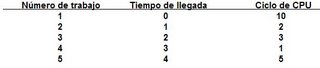
Draw a timeline for each of the following scheduling algorithms (can be useful to calculate first-time start and end for each task).
A) FCFS

B) SJN

C) SRT

D) Round robin (with a time quantum of 2, ignore the change natural context and waits.)

8. With the information from Exercise 7, complete the diagram by calculating the waiting time and turnaround time for each of the work of the following programming algorithm (ignore the overhead due to change in context.)
A) FCFS

B)
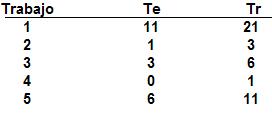
C) SRT

D) Round robin (with a time quantum of 2) 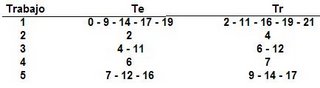


0 comments:
Post a Comment