a) Use the page removal algorithm to analyze the trace FIFO page. For this, check with an asterisk (*) page faults. Then calculate the relationship of failure and success. Value

fault = 9 / 12 = 75% Value
success = 3 / 12 = 25%
 failure ratio = 10/12 = 83% success ratio
= 2 / 12 = 17%
c) "the result corresponded with your intuition? Explique.No, to have 1 page frame than the previous year I thought that would be less page faults.
a) Use the page removal algorithm to analyze the trace FIFO of pages. Page faults indicate with an asterisk (*). Then calculate the relationship of failure and success.
 failure ratio = 5 / 11 = 45% success ratio
= 6 / 11 = 55%
b) With the elimination algorithm LRU pages tracking pages to analyze and calculate the fault relationships and successes. Value

fault = 6 / 11 = 55% success ratio
= 5 / 11 = 45%
c) Which is better? Why do you think is better? Can issue general statements from this example? Why or why not? For this particular case the best algorithm is FIFO, because in terms of failure was less than the LRU. The FIFO obtained a better performance.
d) us define the "most recently used (MRU) as a page removal algorithm, which removes from memory the most recent usage page. Scan tracking page using page requests before and calculate the fault relationships and success. Value
 fault = 6 / 11 = 55% success ratio
= 5 / 11 = 45%
e) Which of the three page removal algorithms is the best and why you think so? For this example the FIFO algorithm as among the 3 is the least scored page faults.
8. To implement an LRU, each page needs a bit of reference. If we aim at a page removal algorithm less frequently used (LFU), in which the page that uses less memory is removed, what would be added to tables? What software changes required to support this new algorithm?
They should add a column to the tables at which point the frequency of use of the pages. The software will be modified to calculate the frequency of usage of pages: Times used / Time elapsed since start of page to calculate the current time.
9. Since the main memory consists of four page frames for public use, use the following table to answer all parts of this problem:

a) Is the content what would exchange FIFO page frame? Exchange the page # 2 which was the fastest loaded into memory.
b) Now Is the content what would exchange LRU page frame? Exchange the page 0 that was used least recently.
c) Is the content what would exchange MRU page frame? Exchange the page # 3 was the one used most recently.
d) Lastly, what content would exchange LFU page frame "with the information in the table could not tell which would exchange
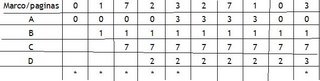
10. Since the main memory consists of four page frames and that a program has been divided into eight pages (0-7):
a) How many page faults occur using FIFO, with a list of requests: 0, 1, 7, 2, 3, 2, 7, 1, 0, 3 if the four page frames are empty at the beginning?

b) How many page faults will be presented in the same conditions but using LRU?
11. Given three subroutines 700, 200 and 500 words each, using the segmentation, the total memory required is the sum of the three sizes (whether the three routines are loaded). However, if you use the paging lose some storage space, because the subroutines rarely fill the last page and this causes internal fragmentation. Determine the total amount of memory wasted due to internal fragmentation when the three subroutines are loaded into memory, using each of the following page sizes:
a)
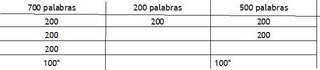
200 words 200 words are wasted memory
b)
 500 words 400 words are wasted in memory
c)  600 words 800 words are wasted in memory
d)  700 words 700 words are wasted memory


0 comments:
Post a Comment