6 -) Consider the following graph of resources for:

a) deadlock Is it in this system?
not b) Are there processes blocked?
No.
c) gráafica What is the result after reduction for P1?
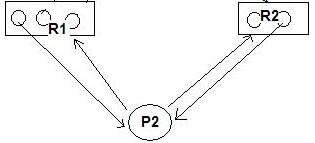
d) Which graph is after reduction by P2?

e) Both P1 and P2 have requested R2:
1) What is the status system if the request is granted before P2 P1?
P1 P2 would be blocked until the end.
2) What is the status of the system if it meets the request of P1 before P2?
P2 P1 would be blocked until the end.
7) Consider the following graph of resources for:

a) Does this system is completely deadlock?
not b) Are there any processes blocked?
If
c) three processes, P1, P2 and P3, R2 resources requested.
1) What applications satisfy you to minimize the number of processes involved in the deadlock? Would meet to P3
2) What applications satisfy to maximize the number of processes participating in the deadlock?
A P3 would give him the resources you need
d) Can you reduce the graphics in part or in total? Explain.
Yes, if P3 is allocated the resources it needs when the other end will have all the necessary resources to finish their task
e) Can you solve the deadlock without selecting a victim? Explain your answer.: No, because resources are insufficient to meet all needs.
8) Consider a computer system with 13 tape drives. All jobs running on this system require up to five tape drives to complete, but each runs for several periods with four units and the fifth request only at the end of execution. The current work is endless.
a) If your operating system supports a policy of very conservative mapping devices, will not start any work, unless you have been assigned the tapes that will require all his performance:
1) What is the maximum of jobs that can be active at the same time?
2 Jobs.
2) What is the minimum and maximum of tape drives that can be idle as a result of this policy? 3 can be idle tape drives.
3) Explain.
As you need to assign all the tapes before starting the task may only be assigned to 2 tasks and only 10 films were used at a time. So 3 tape drives are idle.
b) If your operating system supports the banker's algorithm:
1) What is the maximum work that may be in progress at the same time? This algorithm
may have several works in progress.
2) What is the minimum and maximum number of tape drives that can be idle as a result of this policy?
may be several vacant units.
3) Explain.
With this algorithm, the system assigns the tape drive in as needed.
9-11) in the three systems described in the exercises from 9 to 11, where the devices are of the same type, use the definitions presented in the analysis of the banker's algorithm to answer these questions:
a) Determine "needs Remaining each job on each system.
b) Indicate whether each system is safe or unsafe.
c) If the system is in safe condition, list the sequence of requests and releases that will enable the full implementation of all processes.
d) If the system is in an insecure state, show how it is possible that a deadlock occurs.
9) System A has 12 devices and only one is available.

b) The system is in safe condition and that can meet the needs of the job No. 1.
c) • The device 1 takes the work remaining finishes and releases 6.
• The work 2 and 3 take the devices they need, complete and release devices. • The work 4 takes the necessary devices and ends.
10) The system B has 14 devices and only two are available.

a) The system is in unsafe condition, and that with only 2 available devices can not meet any needs.
b) blockade may occur if any of the processes requesting the missing devices to continue their task.
11) The system C has 12 devices and only two are available. 


0 comments:
Post a Comment